Bird's Nest Fungus
Cyathus striatus
Also called fluted bird's nest, splash cup.
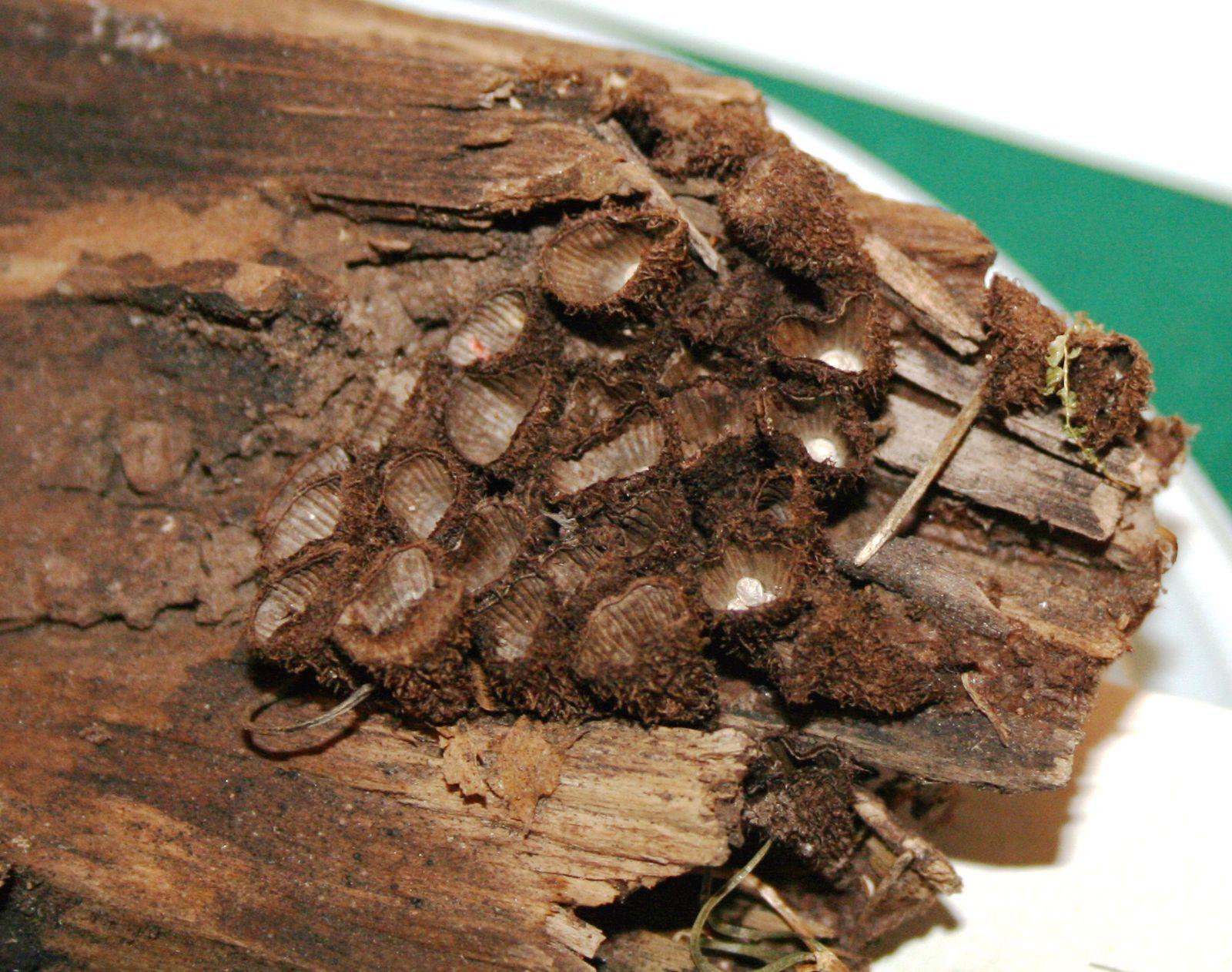
The fluted bird's nest is a tiny cup fungus that looks like a nest full of eggs. The eggs are spore capsules, splashed out by raindrops. It grows in groups on dead wood, twigs and wood-chip mulch, and people find it in garden beds and wonder what it is.
The tell
A tiny, hairy brown cup with grooved inner walls, holding gray egg-like capsules.
Field marks
What to look at
Cap, underside and stem show in a photo. The spore print does not, and it is often the deciding check.
- Cap
- No cap. A small vase- or bell-shaped cup, shaggy and brown to grayish on the outside, shiny gray and finely grooved (fluted) on the inside. Young cups are closed with a whitish lid that falls away.
- Underside
- None. The spores form inside the egg-like capsules.
- Stem
- None. Cups sit directly on the wood.
- Flesh
- Thin and tough. Each egg, or peridiole, is a flattened gray disc attached to the cup by a tiny coiled cord.
- Spore print
- Not taken; spores are held inside the eggs.
- Size
- Cup about 1/4 to 1/2 inch (6 to 12 mm) tall and 1/4 to 3/8 inch (6 to 10 mm) wide.
Where and when
Where and when it grows
- Habitat
- Woods, gardens and landscaped beds, in groups on fallen twigs, wood chips, mulch and rotting wood.
- Grows on
- Dead wood, twigs and wood-chip mulch.
- Season
- Summer through fall; cups persist into winter.
- Range
- Across North America.
Lookalikes
What the bird's nest fungus gets confused with
Each card says how to tell the two apart.
White-egg bird's nest (Crucibulum laeve)
Cup is yellowish to tan and smooth inside, not grooved, and the eggs are whitish.
Field bird's nest (Cyathus olla)
A wider, flaring cup that is smooth inside, not grooved, often in gardens and fields.
Dung bird's nest (Cyathus stercoreus)
Grows on dung and manured soil, with a shaggy outside but a smooth, not grooved, inside and black eggs.
Edibility
What the field guides say
Field guides list the bird's nest fungus as inedible because it is tiny and tough. It is not known to be toxic. Raindrops throw its eggs out of the cup, and each egg's cord snags on nearby plants.
This page states what field guides record. It is not advice to eat, taste or handle anything, and a photo cannot settle edibility. If someone has eaten a wild mushroom that may be toxic, call poison control (1-800-222-1222 in the US) right away, before symptoms start: the deadliest species act hours later.
FAQ
Questions about the bird's nest fungus
What are the eggs in a bird's nest fungus?
They are peridioles, small capsules full of spores. A raindrop hitting the cup splashes them out, and a sticky cord on each one catches on nearby stems and leaves.
Is bird's nest fungus harmful to plants?
No. It breaks down dead wood and mulch and does not attack living plants. It is a common sight in garden beds with wood chips.
Where does bird's nest fungus grow?
In groups on fallen twigs, rotting wood and wood-chip mulch in woods and gardens across North America, mostly from summer into fall.
Sources
Where these facts come from
- Cyathus striatus
MushroomExpert.com
- Cyathus striatus
Fungi Growing on Wood, Gary Emberger (MushroomExpert.com)
- Cyathus striatus
MykoWeb, California Fungi
- Cyathus striatus
Index Fungorum
Waitlist
Hear when it opens
We will send one email when Mushrooms.id opens, and nothing else.
This opens your email app with the request written for you. Send it and we add you to the list. No email app? Write to hello@mushrooms.id with the subject “Add me to the Mushrooms.id waitlist”.