Brown Roll-Rim
Paxillus involutus
Also called poison pax, common roll-rim.
The brown roll-rim is a common brown mushroom of birch woods, parks and lawns, named for its tightly rolled cap edge. It was once widely eaten in Europe until it was found to trigger an immune reaction that destroys red blood cells and has caused deaths.
The tell
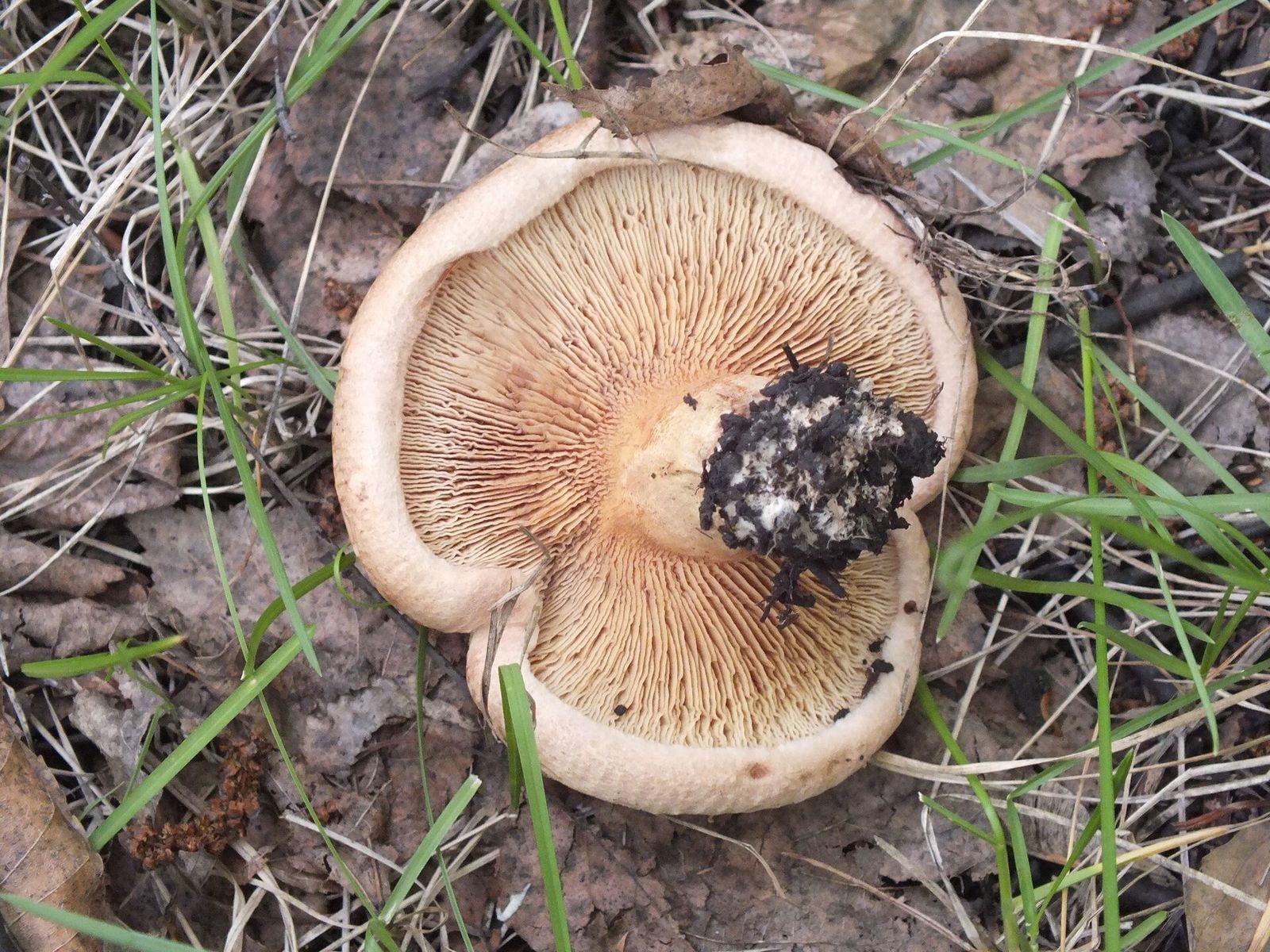
A brown cap with a strongly inrolled, felty edge and crowded gills that run down the stem, peel easily from the cap and bruise dark brown.
Field marks
What to look at
Cap, underside and stem show in a photo. The spore print does not, and it is often the deciding check.
- Cap
- Convex, then flat with a depressed center, 2 to 6 inches across. Yellowish brown to olive-brown or reddish brown, sticky when wet. The edge is strongly inrolled and felty, flattening only in old specimens.
- Underside
- Gills running down the stem, crowded, sometimes forked or connected near the stem. Yellowish olive to pale brown, bruising dark reddish brown. They separate easily from the cap flesh.
- Stem
- Short and often off-center, colored like the cap or paler, bruising darker brown. No ring.
- Flesh
- Thick, yellowish to pale brown, darkening when cut. No milk or latex.
- Spore print
- Brown to yellowish brown.
- Size
- Cap 2 to 6 inches (5 to 15 cm); stem 1 to 3 inches (2.5 to 8 cm) tall.
Where and when
Where and when it grows
- Habitat
- On the ground under birch and other hardwoods and conifers, and in parks, lawns and landscaped areas near planted trees, especially birch.
- Grows on
- Soil, near the roots of host trees.
- Season
- Summer through fall.
- Range
- Across northern North America, and in landscaped areas with planted birch elsewhere.
Lookalikes
What the brown roll-rim gets confused with
Each card says how to tell the two apart.
Milk caps (Lactarius species)
Brown milk caps can have a similar inrolled edge and depressed cap, but their gills release milk or latex when cut and do not peel cleanly away from the cap.
Velvet roll-rim (Tapinella atrotomentosa)
The velvet roll-rim grows on conifer stumps and wood, not soil, and has a stout stem covered in dark brown to black velvet.
Edibility
What the field guides say
Field guides list the brown roll-rim as deadly. Eaten raw or undercooked it causes gastrointestinal illness. More dangerous is an immune reaction: an antigen in the mushroom leads the body to make antibodies, and on a later meal those antibodies attack the person's own red blood cells. The resulting hemolytic anemia can cause kidney failure and death, and the reaction can follow years of eating the mushroom without illness.
This page states what field guides record. It is not advice to eat, taste or handle anything, and a photo cannot settle edibility. If someone has eaten a wild mushroom that may be toxic, call poison control (1-800-222-1222 in the US) right away, before symptoms start: the deadliest species act hours later.
FAQ
Questions about the brown roll-rim
Is the brown roll-rim poisonous?
Yes. Field guides list it as deadly. Besides causing stomach upset, it can trigger an immune reaction in which the body destroys its own red blood cells, leading to kidney failure and death.
Why was the brown roll-rim once considered edible?
It was eaten for generations in parts of Europe, and many people ate it for years without illness. The immune reaction it causes builds with repeated meals. The reaction became widely recognized after the German mycologist Julius Schäffer died in 1944 after eating it.
What does a brown roll-rim look like?
A brown, often sticky cap with a tightly inrolled, felty edge, crowded yellowish-brown gills that run down a short stem and bruise dark brown when touched, and a brown spore print. It grows on soil under birch and other trees.
Sources
Where these facts come from
- Paxillus involutus
MushroomExpert.com
- Paxillus involutus
Fungi Growing on Wood, Gary Emberger (MushroomExpert.com)
- Paxillus involutus
Beaty Biodiversity Museum, University of British Columbia
- Paxillus involutus
Index Fungorum
Waitlist
Hear when it opens
We will send one email when Mushrooms.id opens, and nothing else.
This opens your email app with the request written for you. Send it and we add you to the list. No email app? Write to hello@mushrooms.id with the subject “Add me to the Mushrooms.id waitlist”.