False turkey tail vs turkey tail: how to tell them apart
Quick answer
Turkey tail has a white to cream underside covered in tiny pores, about 3 to 5 per millimeter, visible with a hand lens; false turkey tail is smooth underneath, with no pores at all. The banded top is far less reliable: both are thin, zoned brackets on dead hardwood, so a photo of the top alone is not enough.
Side by side
The tell for each
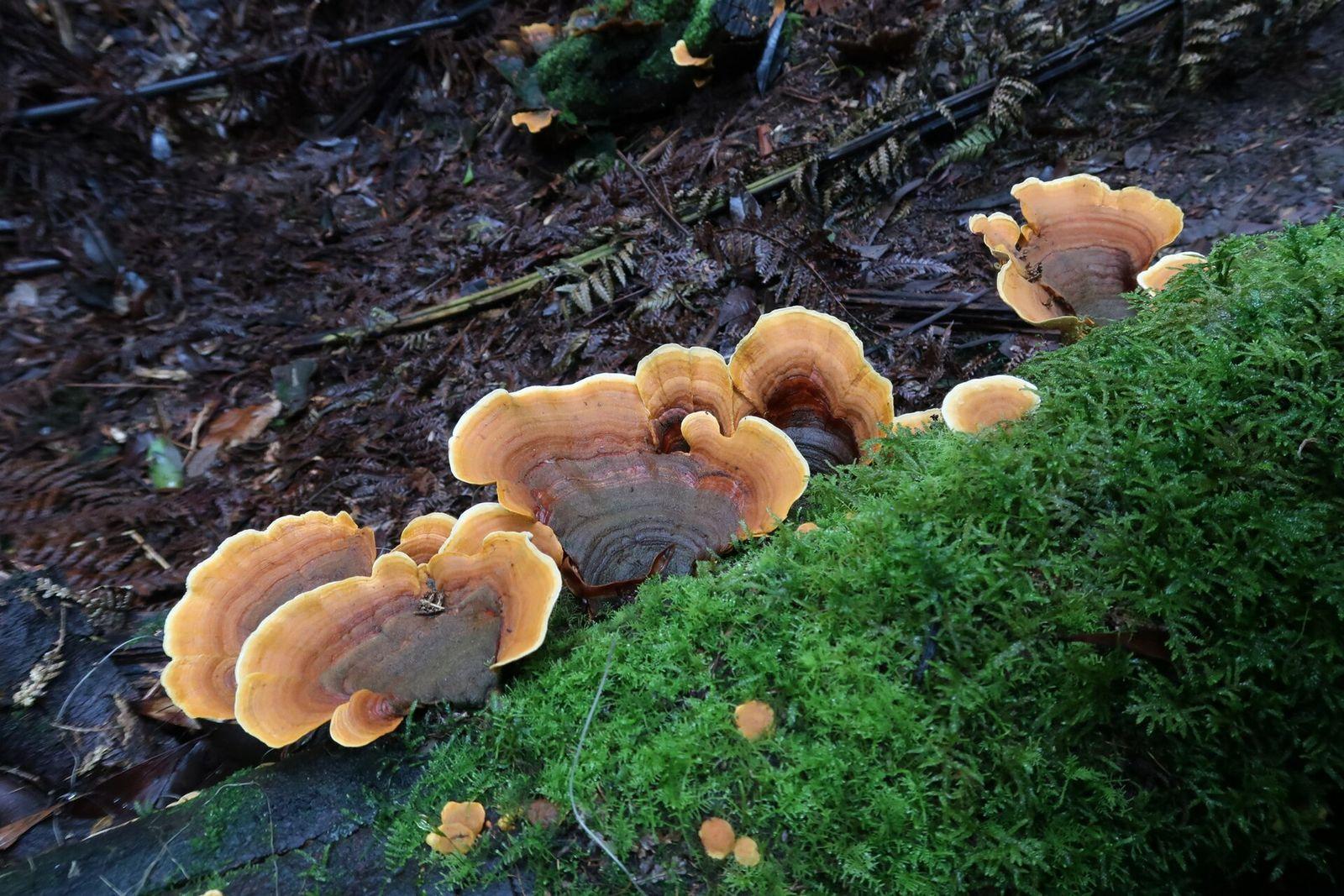
The tellA thin, banded bracket like turkey tail, but with a completely smooth underside and no pores.
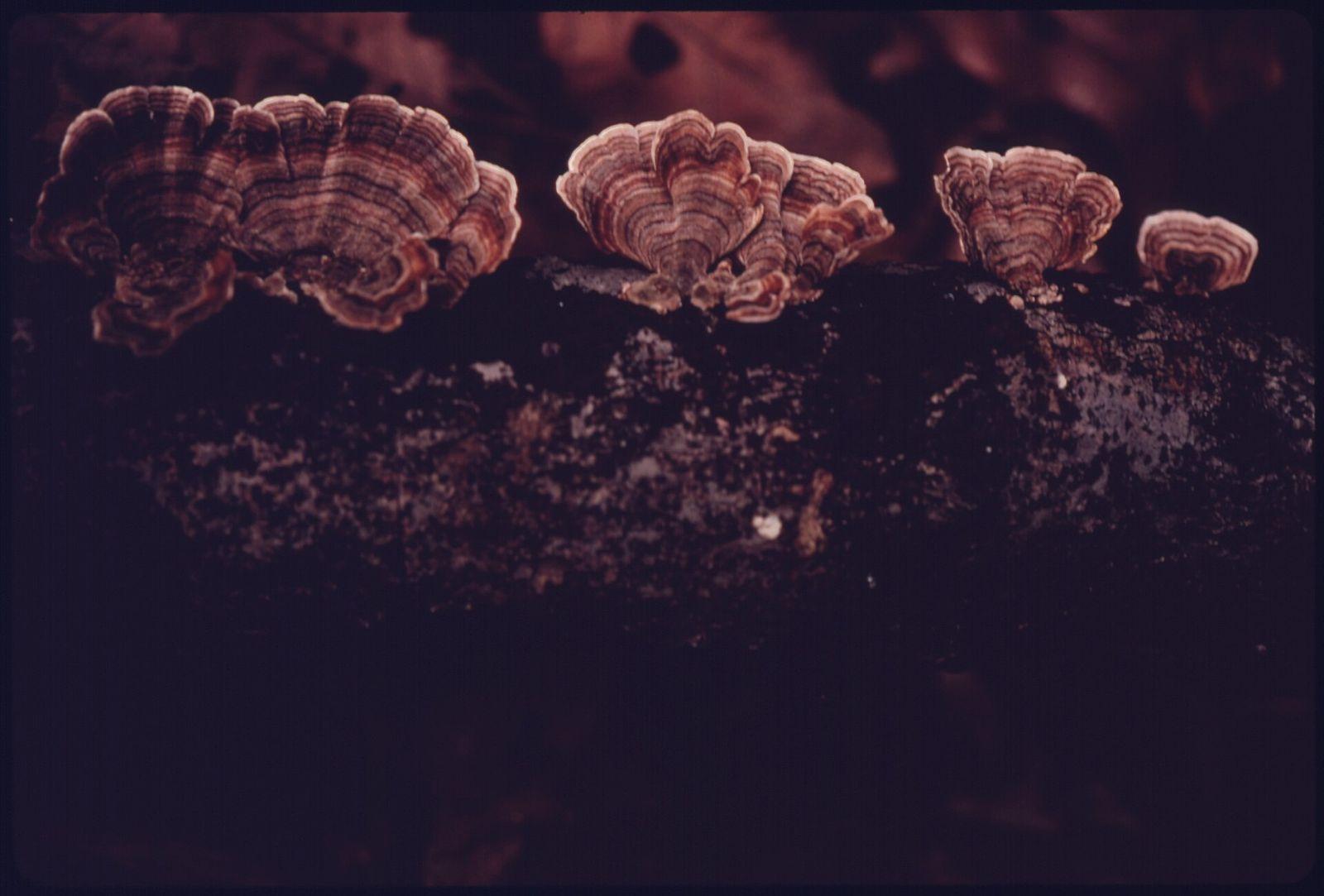
The tellThin, velvety, multicolored banded brackets with a white underside of tiny pores.
How they differ
| Feature | False Turkey Tail | Turkey Tail |
|---|---|---|
| Underside | False Turkey TailSmooth, with no pores, gills or teeth. | Turkey TailCovered in tiny pores, about 3 to 5 per millimeter. |
| Underside color | False Turkey TailBuff to orange-brown or reddish brown. | Turkey TailWhite to cream. |
| Upper surface colors | False Turkey TailZones of orange, red-brown, tan and buff; sometimes green with algae. | Turkey TailSharply contrasting bands of brown, tan, gray, blue, green or rust, with a pale outer edge. |
| Texture of the top | False Turkey TailHairy to velvety when young, often smoother with age. | Turkey TailVelvety to finely hairy. |
| Type of fungus | False Turkey TailA crust fungus (Stereum), not a polypore. | Turkey TailA polypore (Trametes). |
| Size | False Turkey TailBrackets 1 to 3 inches (2.5 to 8 cm) wide and paper-thin. | Turkey TailBrackets 1 to 4 inches (2.5 to 10 cm) wide and about 1/16 inch (1 to 3 mm) thick. |
FAQ
Common questions
How can you tell if it is real turkey tail?
Real turkey tail has a white to cream surface of tiny pores underneath, visible with a hand lens. If the underside is smooth and brownish, it is false turkey tail or another crust fungus.
Is false turkey tail poisonous?
It is not known to be toxic. Field guides list both species as inedible because they are thin and leathery. Turkey tail is the one used for teas and sold in supplements.
Where do turkey tail and false turkey tail grow?
Both grow year round on dead hardwood logs, stumps and fallen branches, often side by side. Turkey tail is one of the most common bracket fungi in North America.
Sources
Where these facts come from
- Stereum ostrea
MushroomExpert.com
- Trametes versicolor: The Turkey Tail
MushroomExpert.com
- Turkey Tail Mushroom
Missouri Department of Conservation
Keep checking
Read both pages in full
- More on the false turkey tail
- More on the turkey tail
- Not sure it is either? Narrow it down with the identification key
This page states what field guides record. It is not advice to eat, taste or handle anything, and a photo cannot settle edibility. If someone has eaten a wild mushroom that may be toxic, call poison control (1-800-222-1222 in the US) right away, before symptoms start: the deadliest species act hours later.
Waitlist
Hear when it opens
We will send one email when Mushrooms.id opens, and nothing else.
This opens your email app with the request written for you. Send it and we add you to the list. No email app? Write to hello@mushrooms.id with the subject “Add me to the Mushrooms.id waitlist”.