Inedible
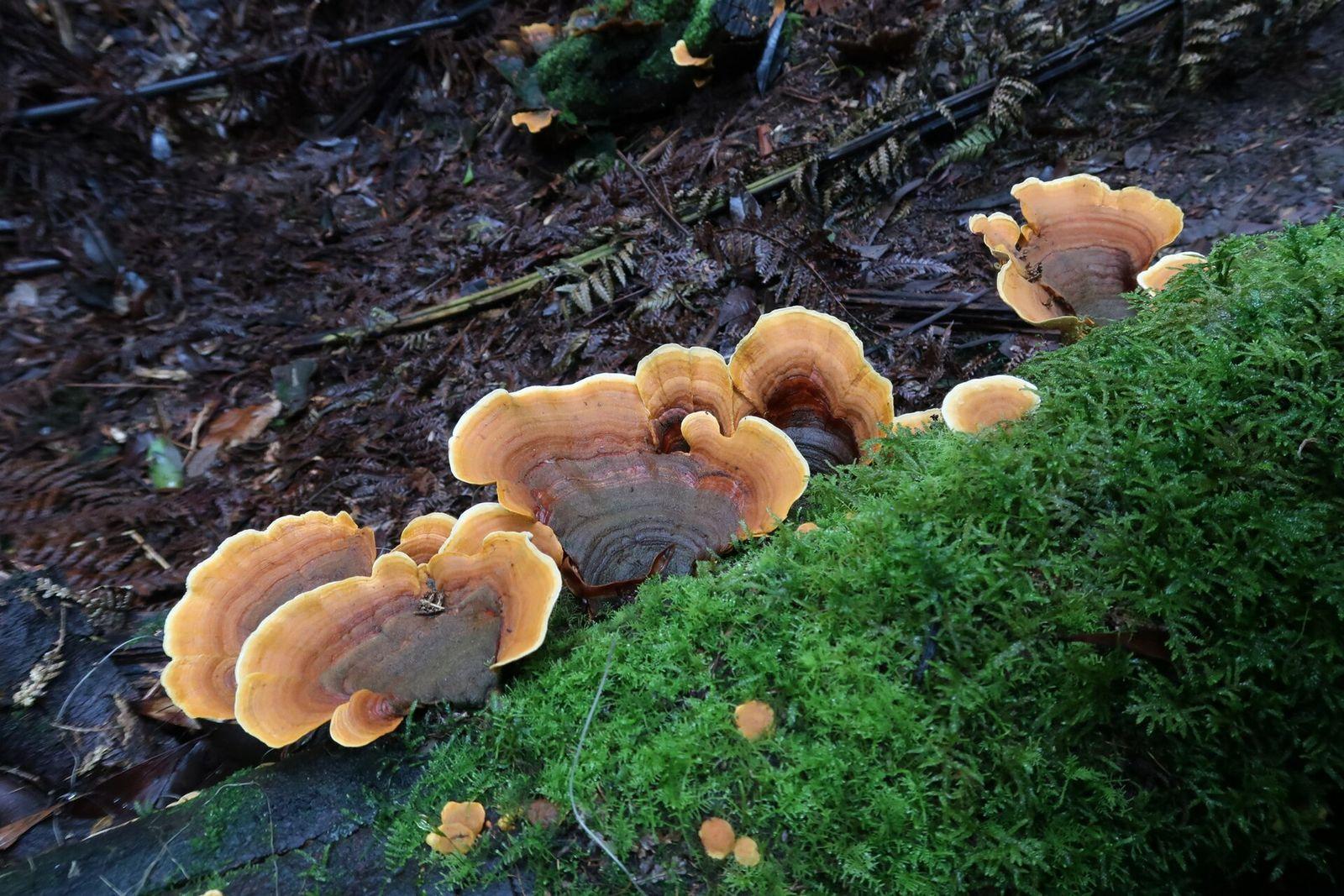
False Turkey Tail
Stereum ostrea
Has a smooth underside with no pores at all, usually brown to orange-tan.
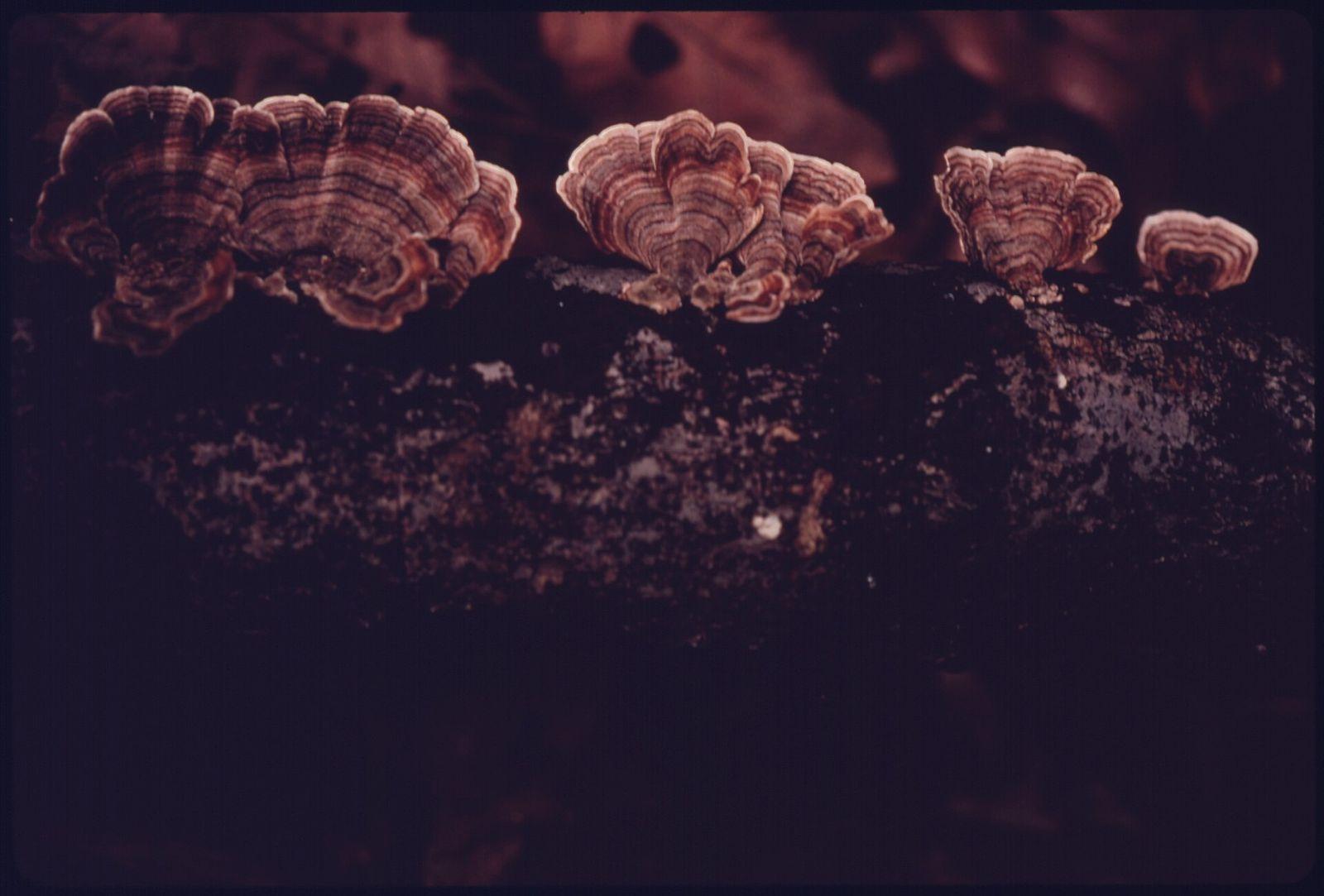
Trametes versicolor
Also called many-zoned polypore.
Turkey tail is a thin, leathery bracket fungus with bands of brown, tan, gray, blue and rust, like a fanned turkey's tail. It grows in overlapping rosettes on dead hardwood all year. It is too tough to eat and is brewed as a tea.
The tell
Thin, velvety, multicolored banded brackets with a white underside of tiny pores.
Field marks
Cap, underside and stem show in a photo. The spore print does not, and it is often the deciding check.
Where and when
Lookalikes
Each card says how to tell the two apart.
Stereum ostrea
Has a smooth underside with no pores at all, usually brown to orange-tan.
Grayish top and a violet to purplish underside of jagged, tooth-like pores.
Grayer and much hairier, with duller zones and a thicker bracket.
A zoned, hairy bracket with gill-like plates on the underside instead of pores.
Edibility
Field guides list turkey tail as inedible because it is tough and leathery. It is dried and simmered in water as a tea, and turkey tail extracts are sold as supplements. It is not known to be toxic.
This page states what field guides record. It is not advice to eat, taste or handle anything, and a photo cannot settle edibility. If someone has eaten a wild mushroom that may be toxic, call poison control (1-800-222-1222 in the US) right away, before symptoms start: the deadliest species act hours later.
FAQ
It is dried and simmered as a tea, and extracts are sold as supplements. It is not eaten as a food because the brackets are thin and leathery.
On a real turkey tail, the white underside is covered in tiny pores that a hand lens shows clearly. False turkey tail has a smooth underside with no pores.
On dead hardwood logs, stumps and branches in woods, parks and yards across North America. It grows and persists year-round.
Sources
MushroomExpert.com
Fungi Growing on Wood, Gary Emberger (MushroomExpert.com)
Missouri Department of Conservation
Index Fungorum
Waitlist
We will send one email when Mushrooms.id opens, and nothing else.
This opens your email app with the request written for you. Send it and we add you to the list. No email app? Write to hello@mushrooms.id with the subject “Add me to the Mushrooms.id waitlist”.