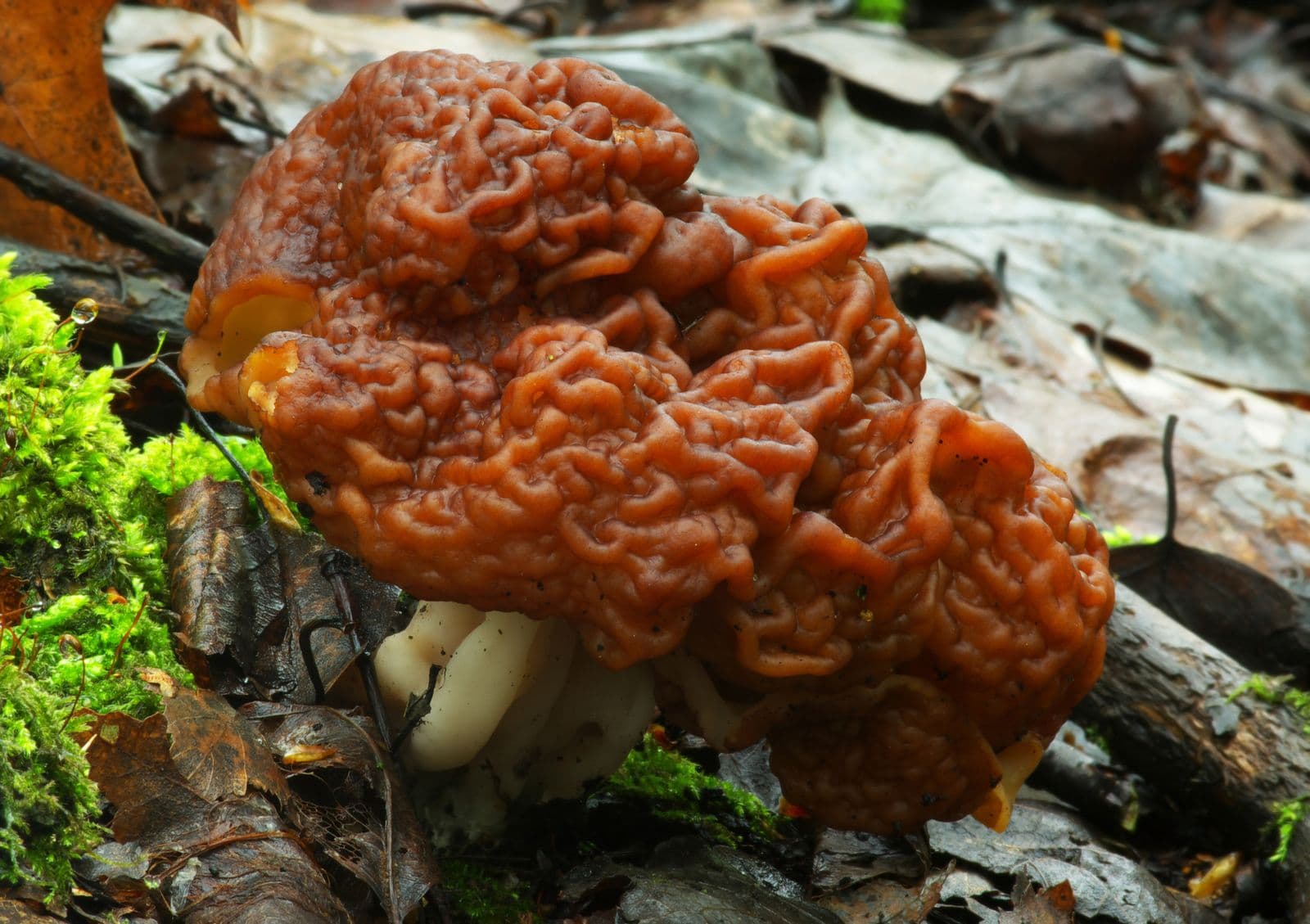
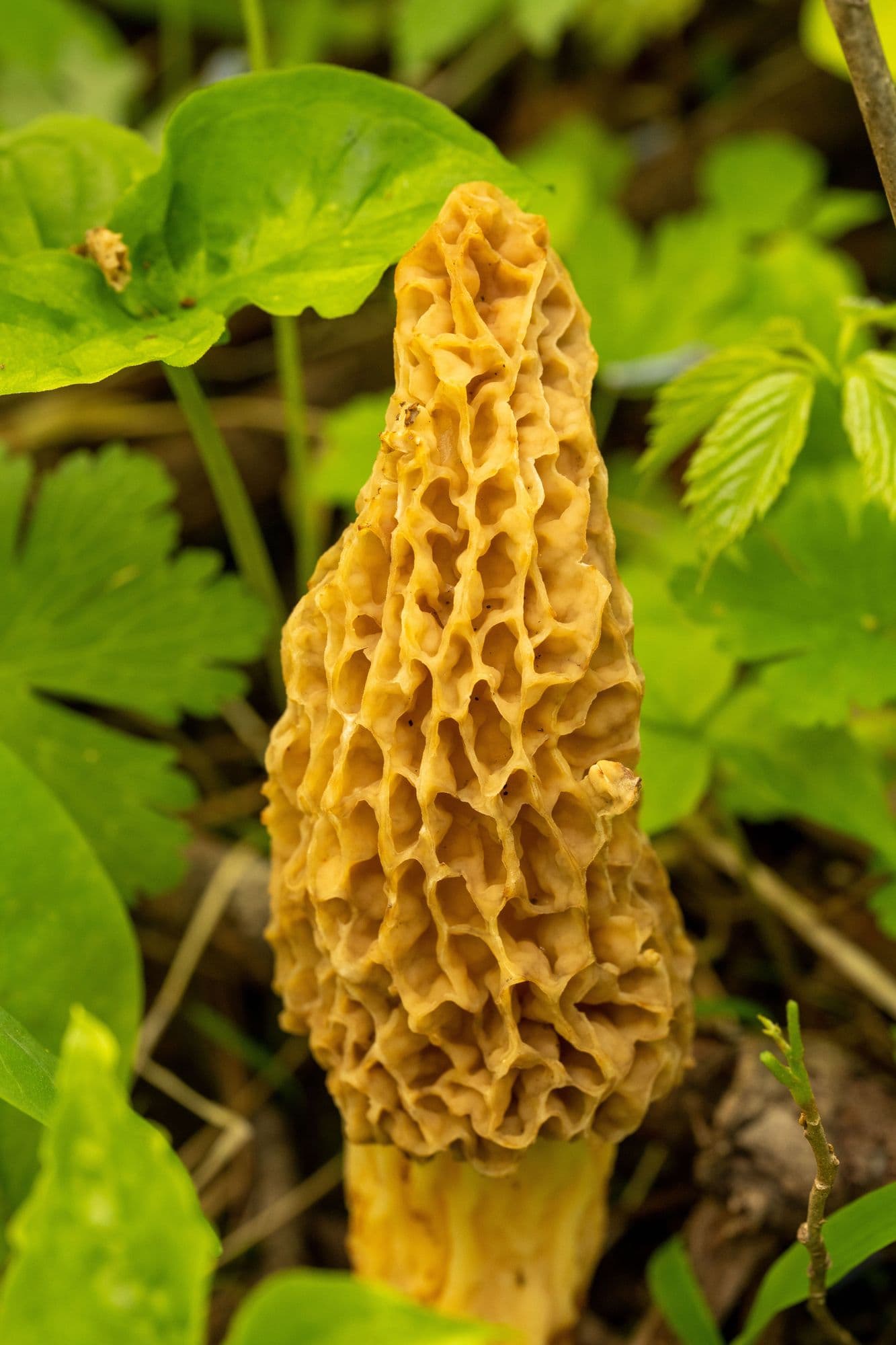
Morel vs false morel
- Toxic: False Morel
Sliced top to bottom, a true morel is hollow from cap tip to stem base. A false morel is chambered or cottony inside, with a brain-like cap.
Quick answer
A black morel is one continuous hollow chamber inside, with a conical cap of pits set between dark, mostly vertical ridges; a false morel has a wrinkled, brain-like reddish-brown cap and is chambered or cottony inside. Dark color alone proves nothing, since false morels can be chestnut to nearly black.
Toxic lookalike
Unlike the black morel, the false morel (Gyromitra esculenta) contains gyromitrin, which breaks down into monomethylhydrazine. The University of British Columbia's Mushrooms Up! guide records symptoms starting 6 to 12 hours after a meal with stomach cramps, vomiting and watery diarrhea, usually resolving in 2 to 5 days; severe cases go on to liver and kidney damage, seizures, coma and, in a few cases, death. The same guide notes that sensitivity varies greatly between people. Heating the mushrooms releases the toxin as a vapor, which is also dangerous to breathe.
If someone has eaten a wild mushroom and feels unwell, or may have eaten one of these, call poison control now: 1-800-222-1222 in the US. Do not wait for symptoms.
Side by side
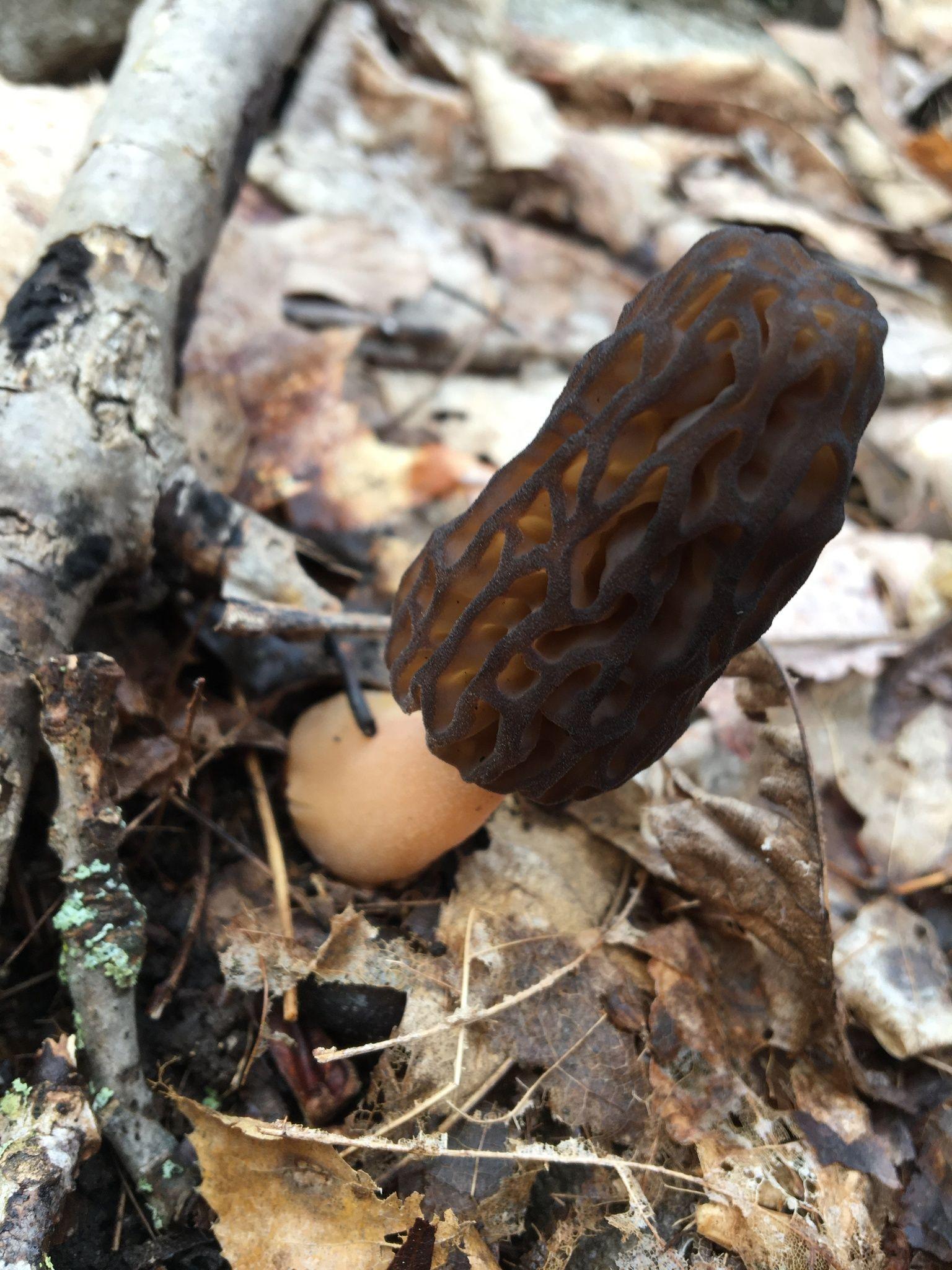
The tellConical honeycomb cap with dark, mostly vertical ridges, hollow from tip to base.
The tellWrinkled, brain-like reddish-brown cap that is chambered or cottony inside, not hollow.
| Feature | Black Morel | False Morel |
|---|---|---|
| Inside when sliced lengthwise | Black MorelOne continuous hollow chamber from cap tip to stem base. | False MorelChambered or folded pockets, often with cottony tissue. |
| Cap surface | Black MorelPits between long, mostly vertical ridges linked by shorter cross-ridges. | False MorelWrinkled, lobed and folded like a brain, with no true pits. |
| Cap shape | Black MorelConical to narrowly egg-shaped. | False MorelIrregular and lumpy. |
| Color | Black MorelPits tan to olive-brown; ridges darken to dark brown or black with age. | False MorelReddish brown to dark chestnut, sometimes nearly black. |
| Where cap meets stem | Black MorelAttached at its lower edge, often with a slight groove. | False MorelThe lower edge touches the stem only in places. |
| Habitat | Black MorelHardwood forests and edges, often near white ash, tulip poplar and wild cherry. | False MorelConifer and mixed forests, often under pines. |
FAQ
No. Black morels are true morels in the genus Morchella and are hollow inside. False morels are Gyromitra species, with brain-like caps and chambered or cottony interiors.
Yes. Like every true morel, a black morel is hollow from the tip of the cap to the base of the stem when sliced lengthwise.
Both appear in spring. Black morels often come up earlier in spring than yellow morels in the same woods, and false morels fruit from March to June depending on latitude and elevation.
Sources
MushroomExpert.com
MushroomExpert.com
Beaty Biodiversity Museum, University of British Columbia
Missouri Department of Conservation
Keep checking
This page states what field guides record. It is not advice to eat, taste or handle anything, and a photo cannot settle edibility. If someone has eaten a wild mushroom that may be toxic, call poison control (1-800-222-1222 in the US) right away, before symptoms start: the deadliest species act hours later.
More comparisons
Sliced top to bottom, a true morel is hollow from cap tip to stem base. A false morel is chambered or cottony inside, with a brain-like cap.
Black morels have dark, mostly vertical ridges and fruit earlier. Yellow morels keep pale ridges in a random honeycomb. Both are hollow inside.
Waitlist
We will send one email when Mushrooms.id opens, and nothing else.
This opens your email app with the request written for you. Send it and we add you to the list. No email app? Write to hello@mushrooms.id with the subject “Add me to the Mushrooms.id waitlist”.