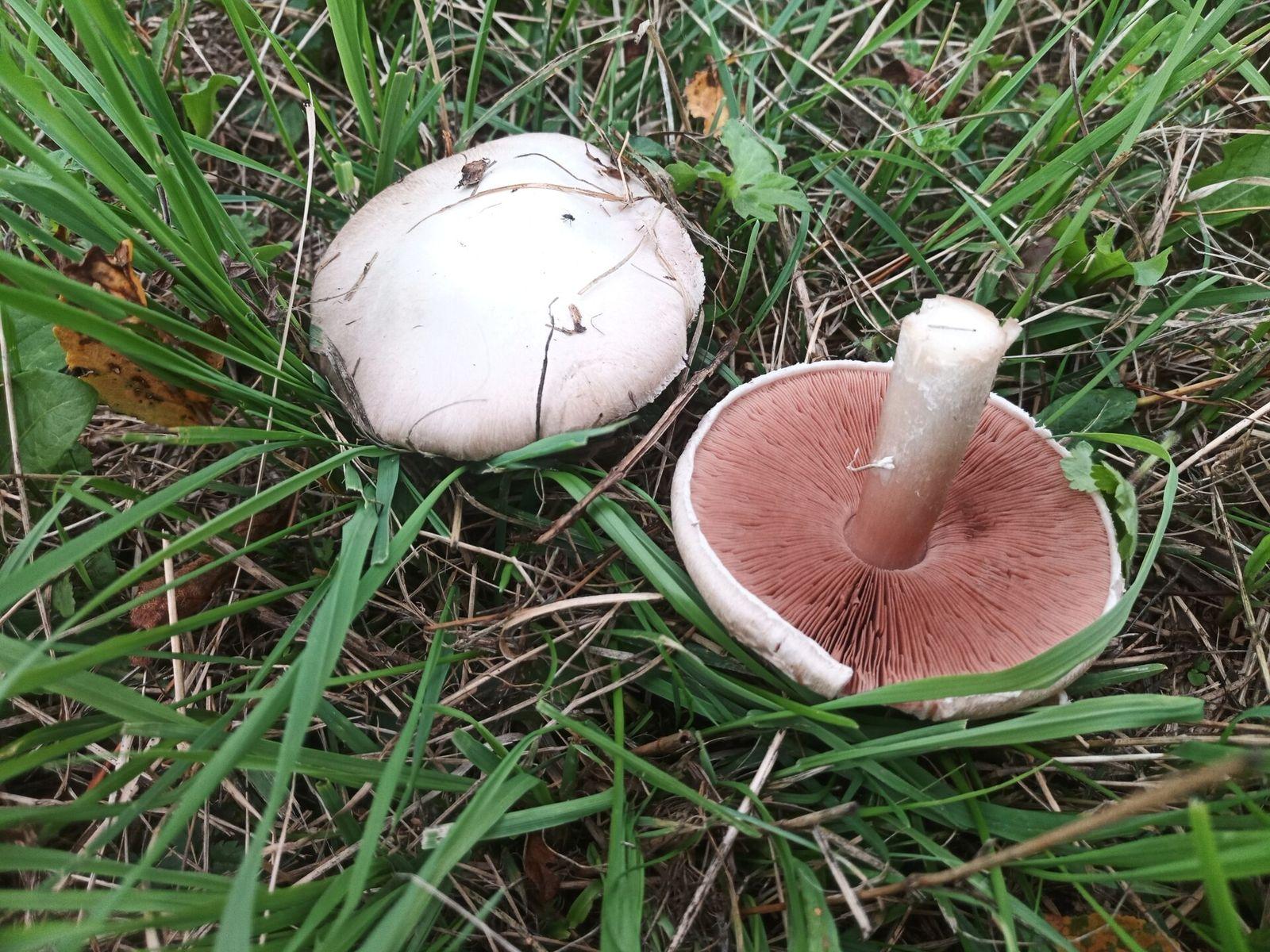
Edible
Meadow Mushroom
Agaricus campestris
Grows in grass, has free pink gills that turn chocolate brown, a ring on the stem and a dark chocolate-brown spore print.
Entoloma sinuatum
Also called livid entoloma, lead poisoner.
The livid pinkgill is a large, pale gray mushroom with gills that start yellowish and turn pink. It grows under hardwoods in late summer and fall and causes severe gastrointestinal poisoning. It gets mistaken for edible gray or white mushrooms.
Entoloma sinuatum
Photo coming
The tell
A large gray cap with yellowish gills that turn pink, a pink spore print and a mealy smell.
Field marks
Cap, underside and stem show in a photo. The spore print does not, and it is often the deciding check.
Where and when
Lookalikes
Each card says how to tell the two apart.
Also pink-spored and mealy-smelling, but smaller, with a soft, chamois-like white to pale gray cap and gills that run down the stem.
Agaricus campestris
Grows in grass, has free pink gills that turn chocolate brown, a ring on the stem and a dark chocolate-brown spore print.
Entoloma abortivum
Photo coming
Entoloma abortivum
Its gilled form is a smaller gray Entoloma with gills running down the stem, usually near honey mushrooms and often with whitish aborted lumps nearby.
Edibility
Field guides list the livid pinkgill as poisonous. It causes severe vomiting, diarrhea and abdominal cramps, usually within a few hours, and cases are recorded that needed hospital treatment for dehydration. The toxin has not been identified. In Europe it is one of the more frequent causes of mushroom poisoning.
This page states what field guides record. It is not advice to eat, taste or handle anything, and a photo cannot settle edibility. If someone has eaten a wild mushroom that may be toxic, call poison control (1-800-222-1222 in the US) right away, before symptoms start: the deadliest species act hours later.
FAQ
Yes. Field guides list it as poisonous, causing severe gastrointestinal illness: vomiting, diarrhea and cramps, starting within a few hours. The toxin responsible has not been identified.
A large, pale gray to yellowish-gray cap on a thick white stem, with gills that are yellowish when young and pink when mature. It has no ring, a mealy smell and a pink spore print.
Entolomas have pink to salmon spore prints and gills that turn pink as they mature. Many have a mealy smell. Telling species apart often takes microscopic features.
Sources
TexasMushrooms.org
First Nature
Index Fungorum
Waitlist
We will send one email when Mushrooms.id opens, and nothing else.
This opens your email app with the request written for you. Send it and we add you to the list. No email app? Write to hello@mushrooms.id with the subject “Add me to the Mushrooms.id waitlist”.