Poison Pie

Hebeloma crustuliniforme

Toxic

Also called fairy cake mushroom, fairy cake hebeloma.

The poison pie is a pale, biscuit-colored mushroom with a sticky cap, brown gills and a radish smell. It grows under trees in woods, parks and lawns, often in rings, and causes gastrointestinal poisoning. Its name comes from its pastry color.

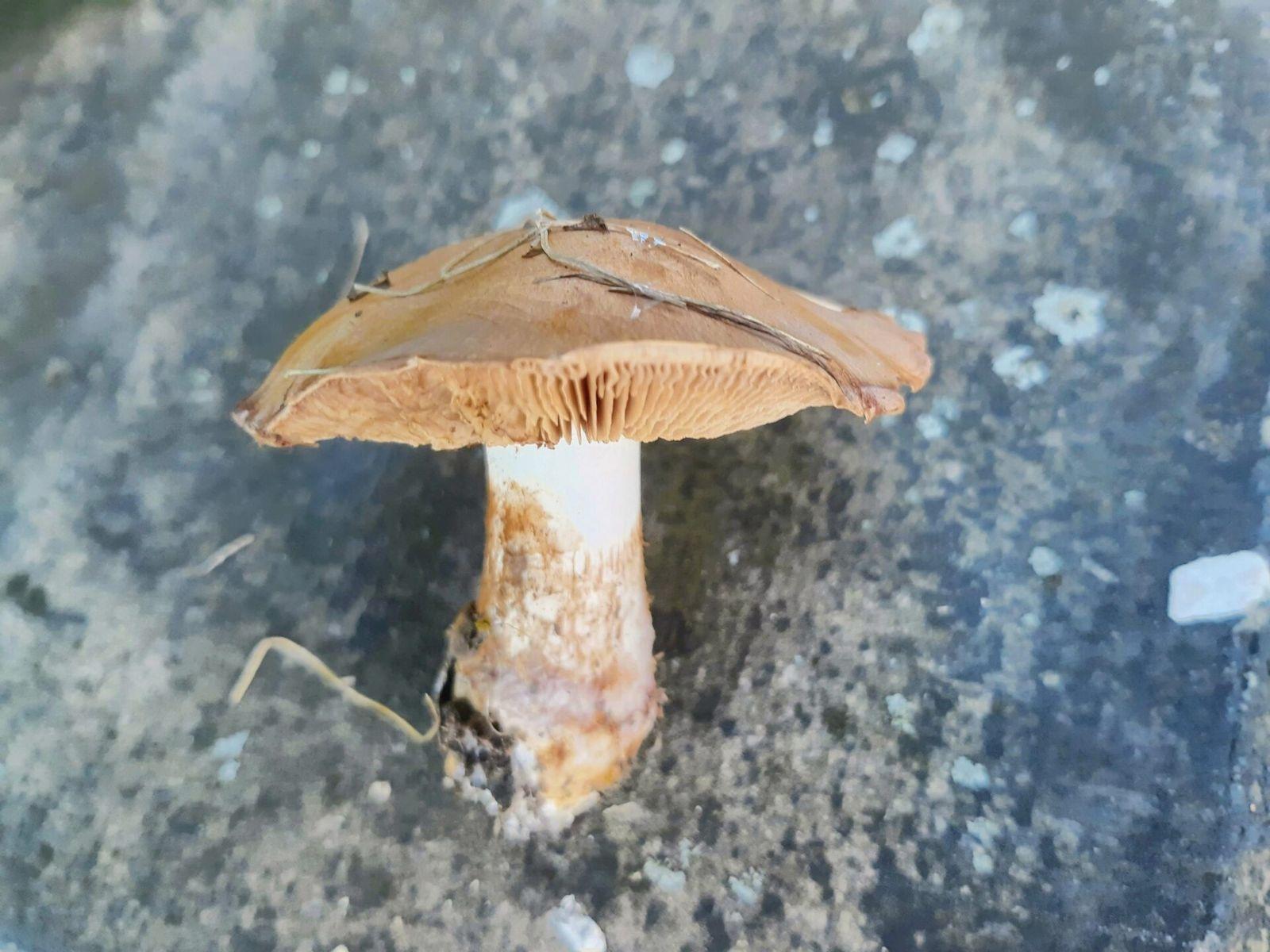
A poison pie with a tan cap, brownish gills and a pale stem, photographed against a gray stone

The tell

Pale tan, sticky cap; in damp weather the gill edges carry tiny beads of water, and it smells of radish.

Field marks

What to look at

Cap, underside and stem show in a photo. The spore print does not, and it is often the deciding check.

Cap
Convex to flat with a broad bump, sticky when wet. Whitish to pale tan or buff, darker brownish at the center, with an inrolled margin when young.
Underside
Crowded gills, pale at first, becoming clay brown. In humid weather the gill edges weep tiny droplets of water that dry into brown spots.
Stem
Whitish, with a powdery or scurfy upper portion. No ring and no cup.
Flesh
Thick, white and firm. Smell of radish. Taste bitter.
Spore print
Dull brown to clay brown.
Size
Cap 1 1/2 to 3 1/2 inches (4 to 9 cm) wide; stem 1 1/2 to 3 inches (4 to 8 cm) tall.

Where and when

Where and when it grows

Habitat
Woods, parks and lawns with trees, often in groups, arcs or rings under hardwoods and conifers.
Grows on
Soil, mycorrhizal with tree roots.
Season
Late summer through fall; fall through winter in California.
Range
Across North America, where the name covers a group of similar Hebeloma species.

Edibility

What the field guides say

Toxic

Field guides list the poison pie as poisonous. It causes vomiting, diarrhea and abdominal cramps within a few hours of being eaten. The toxins are not well characterized, and field guides treat related Hebeloma species the same way.

This page states what field guides record. It is not advice to eat, taste or handle anything, and a photo cannot settle edibility. If someone has eaten a wild mushroom that may be toxic, call poison control (1-800-222-1222 in the US) right away, before symptoms start: the deadliest species act hours later.

FAQ

Questions about the poison pie

Is poison pie mushroom poisonous?

Yes. Field guides list it as poisonous, causing gastrointestinal illness with vomiting, diarrhea and cramps. The toxins are not well characterized.

What does poison pie look like?

A pale tan, sticky cap with a darker center, brown gills, and a whitish stem with a powdery top. It smells of radish, and in damp weather its gill edges carry tiny water droplets.

Where does poison pie grow?

Under trees in woods, parks and lawns, often in rings or arcs. It fruits in late summer and fall, and through the winter in California.

Sources

Where these facts come from

  1. Hebeloma crustuliniforme

    MushroomExpert.com

  2. Hebeloma crustuliniforme

    MykoWeb, California Fungi

Waitlist

Hear when it opens

We will send one email when Mushrooms.id opens, and nothing else.

Email us to join

This opens your email app with the request written for you. Send it and we add you to the list. No email app? Write to hello@mushrooms.id with the subject “Add me to the Mushrooms.id waitlist”.