Matsutake

Tricholoma murrillianum

Edible

Also called American matsutake, western matsutake, pine mushroom.

The western matsutake is a firm white mushroom of western conifer forests, prized in Japanese cooking and gathered commercially in the Pacific Northwest. Its spicy smell is the key field mark. Its most dangerous lookalike is Smith's amanita, which causes kidney failure.

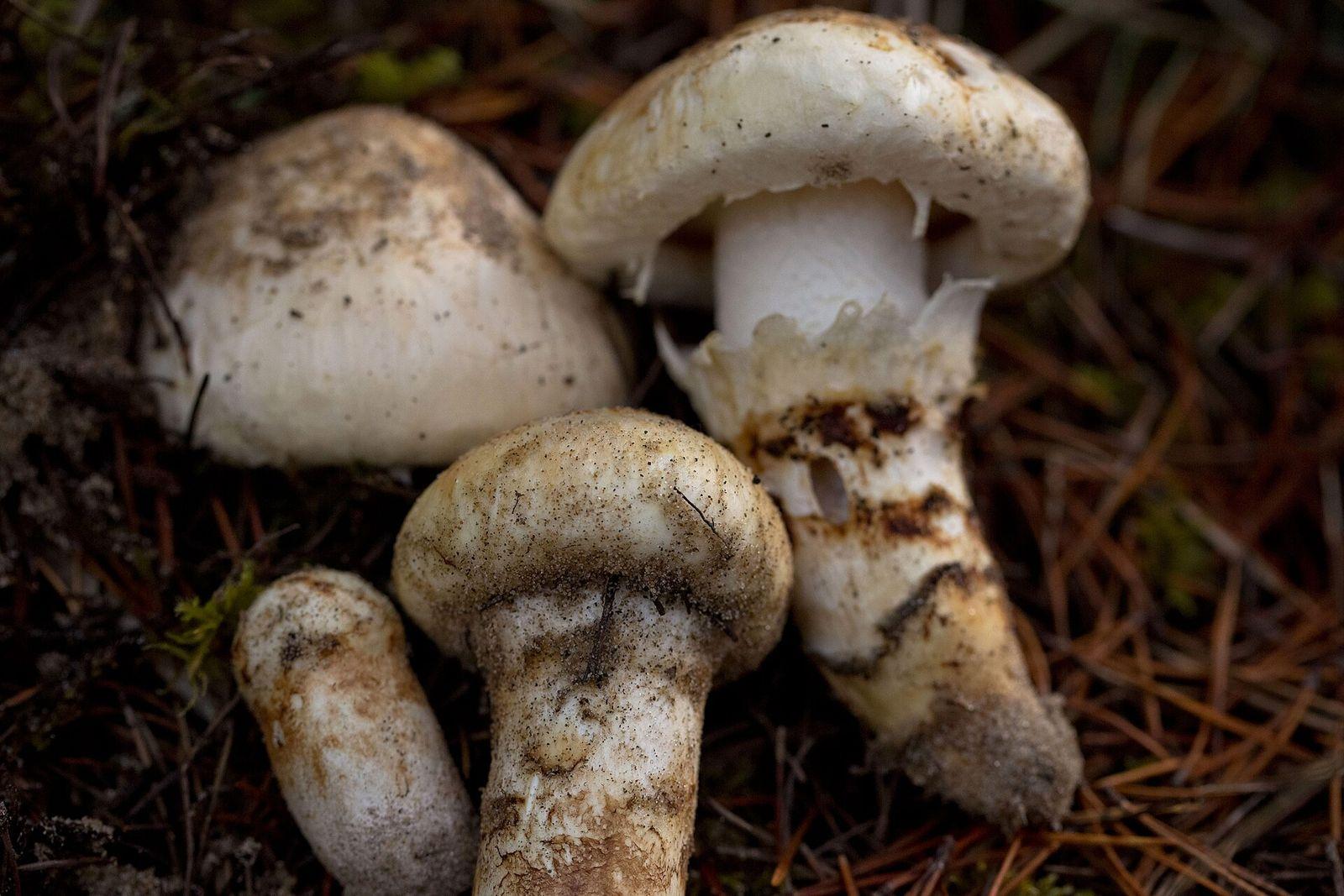
Four stout white matsutake mushrooms with shaggy stems, one showing a ragged ring, on the forest floor

The tell

A firm white mushroom with a sheathing ring on the stem and a strong, spicy, cinnamon-like smell.

Field marks

What to look at

Cap, underside and stem show in a photo. The spore print does not, and it is often the deciding check.

Cap
Convex, flattening with age, 2 to 8 inches across. White when young, developing brownish streaks, fibers or scales with age, dry to slightly sticky. The edge is inrolled and cottony when young.
Underside
Gills attached or notched at the stem, crowded. White to ivory, developing brown to reddish brown spots and stains with age.
Stem
Thick, very firm, and tapering toward the base. A cottony or membranous veil forms a flaring ring near the top, and below it the stem is sheathed in white tissue that develops brownish scales.
Flesh
White and very firm, not changing on exposure. Smell strong and distinctive, described as spicy, like cinnamon and pine, often called a mix of red-hot candies and dirty socks.
Spore print
White.
Size
Cap 2 to 8 inches (5 to 20 cm); stem 2 to 6 inches (5 to 15 cm) tall.

Where and when

Where and when it grows

Habitat
In conifer and mixed forests, usually in sandy or well-drained soil under lodgepole pine, Douglas-fir, hemlock and tanoak. Young specimens often push up the duff without breaking through.
Grows on
Soil, near the roots of conifers and tanoak.
Season
Fall, with later fruitings in California.
Range
Western North America, from Alaska and British Columbia through the Pacific Northwest to California and into the northern Rocky Mountains. A related matsutake grows in the East.

Edibility

What the field guides say

Edible

Field guides list the matsutake as a choice edible, and it is harvested commercially in western North America, much of it exported to Japan. Smith's amanita, which grows in the same Pacific Northwest forests, has caused poisonings in matsutake hunters: digestive symptoms appear several hours after eating, followed days later by kidney failure.

This page states what field guides record. It is not advice to eat, taste or handle anything, and a photo cannot settle edibility. If someone has eaten a wild mushroom that may be toxic, call poison control (1-800-222-1222 in the US) right away, before symptoms start: the deadliest species act hours later.

FAQ

Questions about the matsutake

What does matsutake smell like?

Strong and spicy, often compared to cinnamon and pine. The mycologist David Arora described it as a cross between red-hot candies and dirty socks. The smell is the main feature that separates it from white lookalikes.

How do you tell matsutake from Smith's amanita?

By smell and texture. Matsutake has a strong spicy smell and a very firm, dense stem with a sheathing ring. Smith's amanita lacks that smell, has a softer, more crumbly stem, and often has scaly bands on a swollen or rooting base.

Where does matsutake grow?

In western North America under lodgepole pine, Douglas-fir, hemlock and tanoak, in sandy or well-drained soil. It fruits in the fall, often hidden under the duff.

Sources

Where these facts come from

  1. Tricholoma murrillianum

    MushroomExpert.com

  2. Tricholoma murrillianum

    Beaty Biodiversity Museum, University of British Columbia

  3. Tricholoma murrillianum

    MykoWeb, California Fungi

Waitlist

Hear when it opens

We will send one email when Mushrooms.id opens, and nothing else.

Email us to join

This opens your email app with the request written for you. Send it and we add you to the list. No email app? Write to hello@mushrooms.id with the subject “Add me to the Mushrooms.id waitlist”.