Fairy Ring Mushroom

Marasmius oreades

Edible

Also called scotch bonnet, fairy ring champignon.

The fairy ring mushroom grows in rings and arcs in lawns and pastures, often marked by a circle of darker or dead grass. It is one of the most common lawn mushrooms, and it shares that habitat with the toxic fool's funnel.

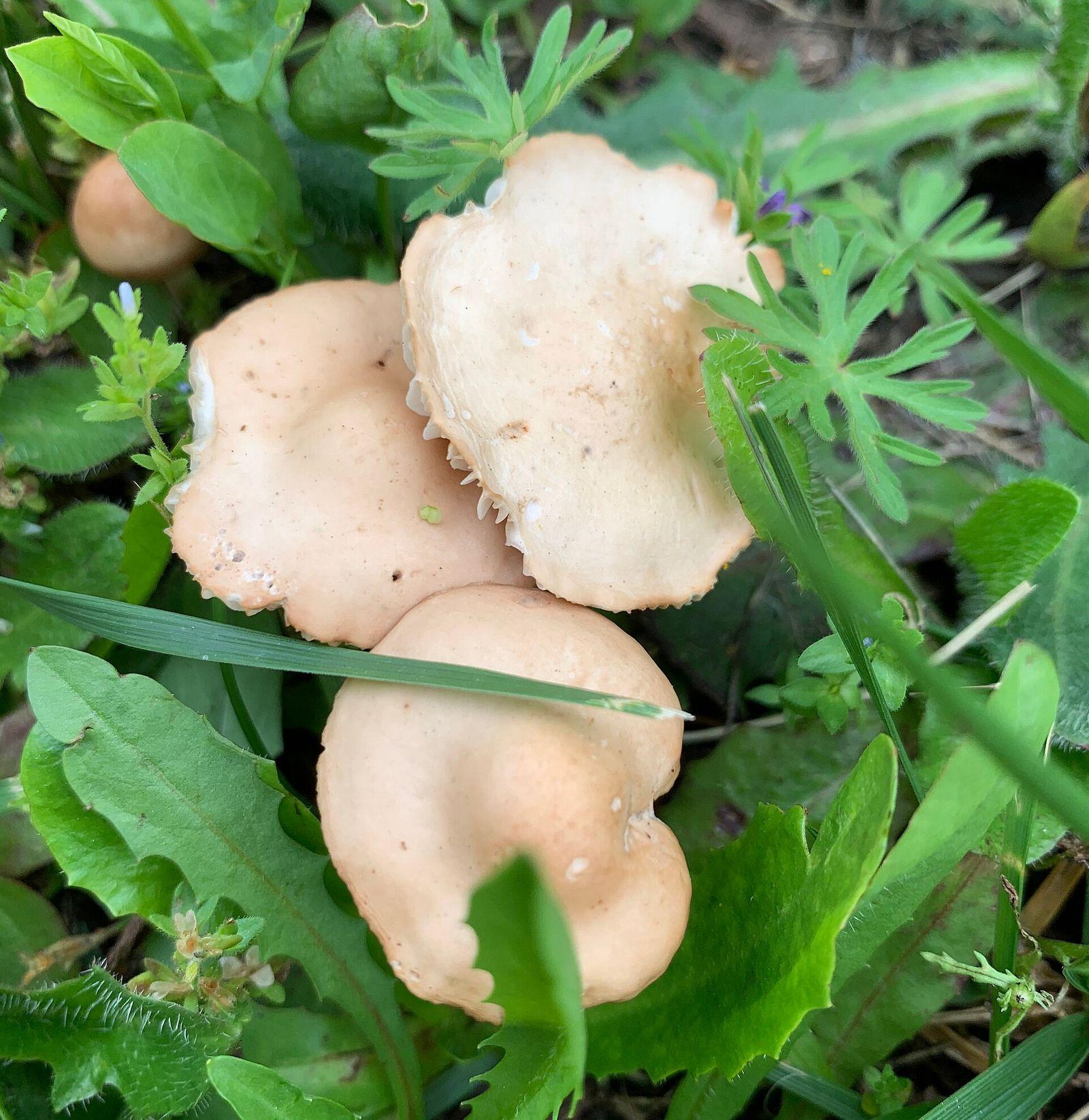
Pale tan fairy ring mushrooms with wavy caps among grass and green leaves

The tell

Tan, bell-shaped caps in rings in grass, widely spaced gills, and a tough, wiry stem that twists without snapping.

Field marks

What to look at

Cap, underside and stem show in a photo. The spore print does not, and it is often the deciding check.

Cap
Bell-shaped to convex, flattening with a broad raised center, 0.5 to 2 inches across. Tan to buff or reddish tan, drying paler. Smooth. Dried caps revive when wet.
Underside
Gills free or narrowly attached, broad and widely spaced. Whitish to pale tan.
Stem
Thin, tough and pliant, colored like the cap or paler. It twists without breaking. No ring.
Flesh
Thin and whitish. Smell mild.
Spore print
White.
Size
Cap 0.5 to 2 inches (1 to 5 cm); stem 1 to 3 inches (2.5 to 8 cm) tall.

Where and when

Where and when it grows

Habitat
Lawns, pastures, meadows and grassy roadsides, in full or partial rings that grow outward a little each year.
Grows on
Soil and grass thatch.
Season
Late spring through fall, after rain.
Range
Throughout North America.

Edibility

What the field guides say

Edible

Field guides list the fairy ring mushroom as edible. Guides stress the widely spaced gills, tough stem and white spore print, because lawns also produce the fool's funnel, which contains muscarine, and small brown species with amatoxins.

This page states what field guides record. It is not advice to eat, taste or handle anything, and a photo cannot settle edibility. If someone has eaten a wild mushroom that may be toxic, call poison control (1-800-222-1222 in the US) right away, before symptoms start: the deadliest species act hours later.

FAQ

Questions about the fairy ring mushroom

Are fairy ring mushrooms poisonous?

Marasmius oreades is listed as edible in field guides. The risk in lawns is confusion with the fool's funnel, which also grows in rings and contains muscarine, and with small brown mushrooms such as the fool's conecap.

What causes a fairy ring in the lawn?

The fungus spreads outward in a circle from a central point, feeding on soil organic matter. The grass at the advancing edge often grows darker and faster, while the zone just inside can thin or die, and the mushrooms appear along the ring after rain.

How do you tell a fairy ring mushroom from fool's funnel?

Fairy ring mushrooms are tan, with widely spaced gills that do not run down the stem and a tough stem that twists without snapping. Fool's funnel is white to buff, with crowded gills that run down a short stem.

Sources

Where these facts come from

  1. Marasmius oreades

    MushroomExpert.com

  2. Fairy Ring Mushroom

    Missouri Department of Conservation

  3. Marasmius oreades

    MykoWeb, California Fungi

  4. Marasmius oreades

    Index Fungorum

Waitlist

Hear when it opens

We will send one email when Mushrooms.id opens, and nothing else.

Email us to join

This opens your email app with the request written for you. Send it and we add you to the list. No email app? Write to hello@mushrooms.id with the subject “Add me to the Mushrooms.id waitlist”.